




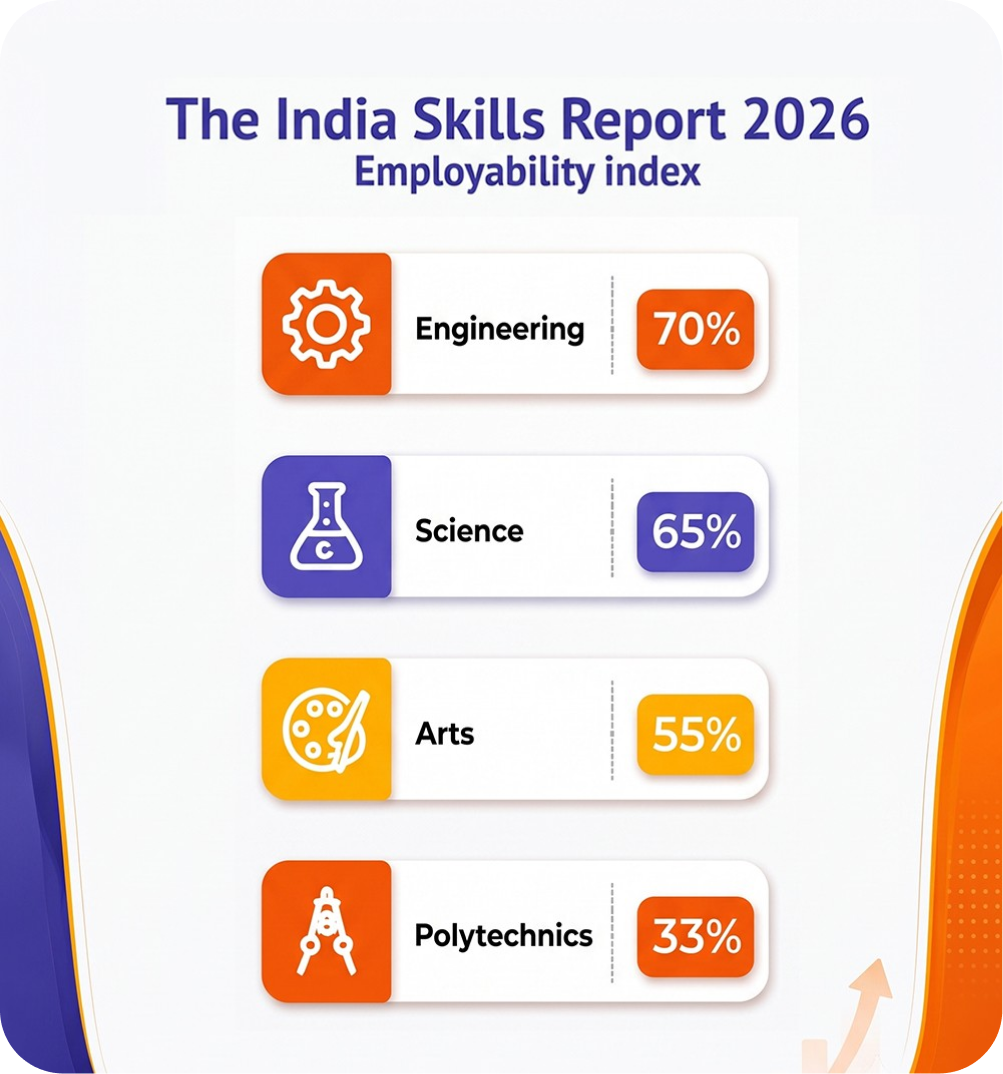
According to the India Skills Report 2026, only 56% of graduates are employable, with employability varying widely across disciplines (as shown in the graphic). This underscores the need for higher education institutions to redesign learning experiences that equip students with the practical skills, critical thinking, and industry readiness required for today’s workforce.
India’s higher education ecosystem is undergoing a major transformation, driven by the National Education Policy (NEP) 2020 and emerging policy initiatives that emphasize inquiry-based, multidisciplinary, and outcome-focused learning. At the same time, the gap between academic learning and workforce expectations remains significant.
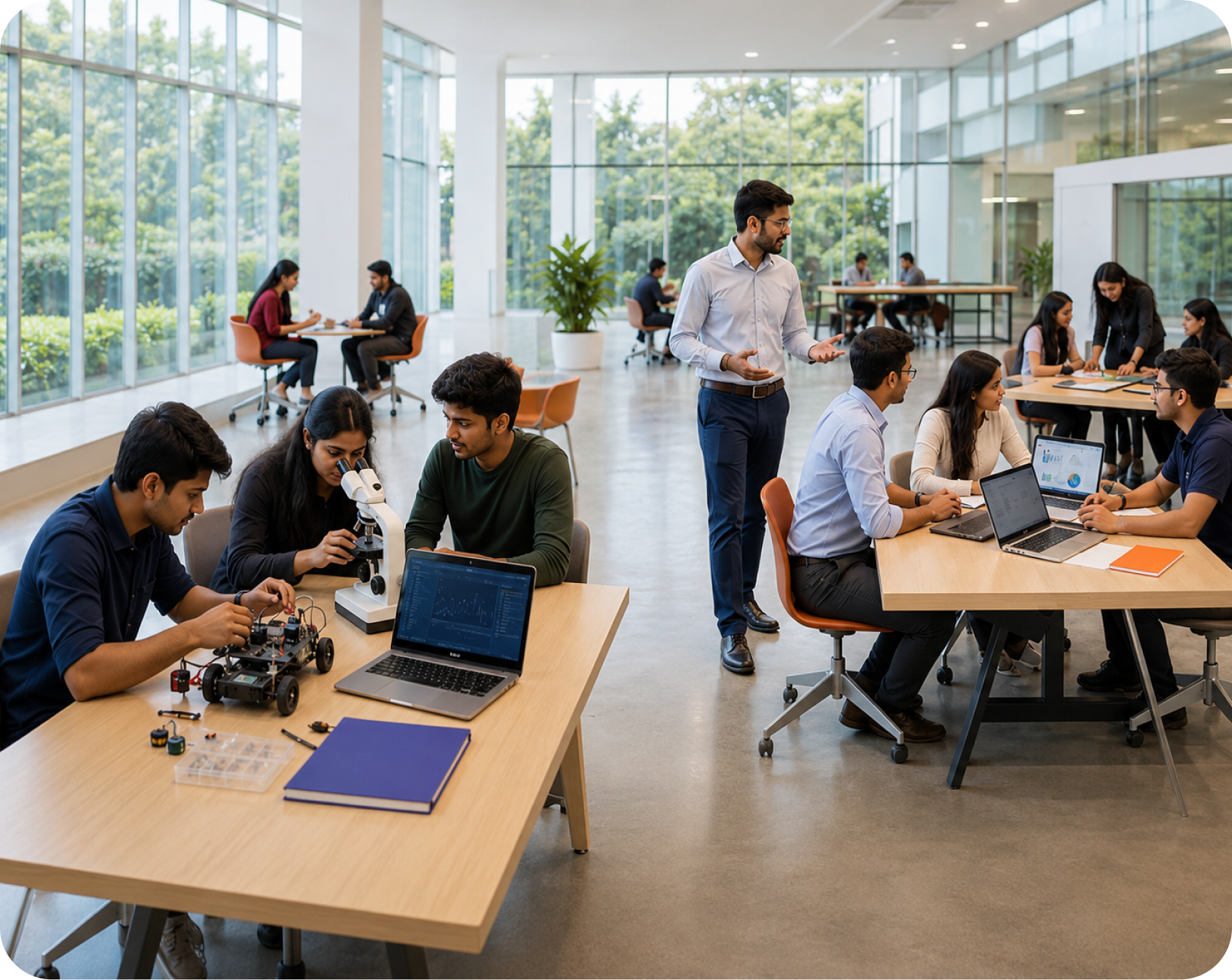
A stronger academic core, & skills it can’t teach alone.
A strong academic foundation will always matter. But students also need to build essential life skills communication, collaboration, critical thinking and the ability to apply their knowledge to solve real-world problems.
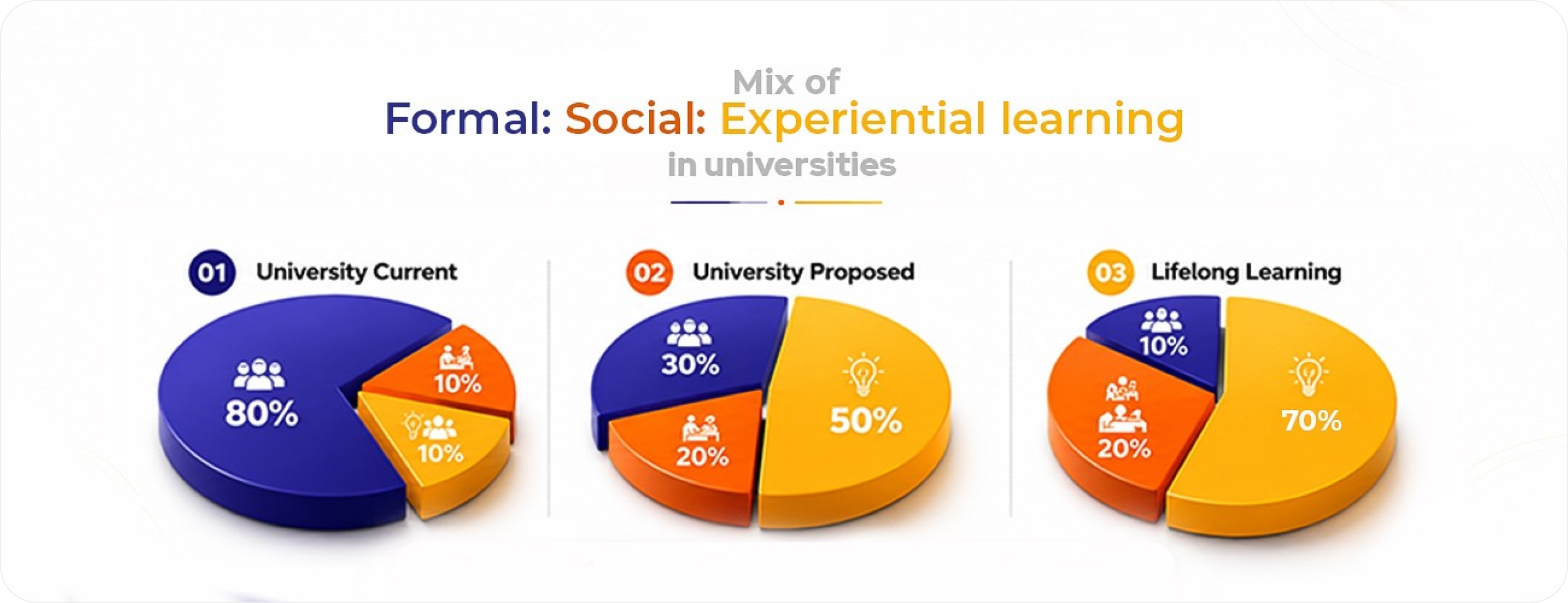
Formal, social, and experiential working together.
Learning cannot be limited to classroom lectures alone. It should combine formal learning, social learning through peers, faculty, mentors and industry experts, and experiential learning through hands-on projects, simulations, and real-world challenges.
Higher education faces a pivotal shift: employers increasingly evaluate graduates not by accumulated credit hours or cumulative GPA, but by demonstrated, verifiable competencies and digital fluency.
The traditional Learning Management System has served primarily as a passive administrative repository hosting syllabi, PDFs, and a static gradebook. They need a new kind of LMS as shown below:
To prepare graduates for a rapidly evolving, AI-augmented workforce, the digital learning infrastructure must undergo a strategic transformation.
A modern LMS needs to be built around the learner, not organised solely around the course catalogue.
The system should actively manage and grow each student’s learning capacity and capabilities, not just record them.
Static & Siloed: Courses are updated every few years. Content is often disconnected from real-world market shifts.
Dynamic & Market-Mapped: Cross-reference university curricula with real-time global job market trends to identify emerging industry skills.
Grade-Based: Evaluates students on a GPA scale based on rote memorization or rigid test structures.
Competency-Based: Tracks students through a “Skill Matrix,” measuring tangible 21st-century proficiencies (e.g., data literacy, agile thinking).
One-Size-Fits-All: Every student in a major takes the exact same linear path, regardless of prior knowledge or career goals.
Adaptive: Modifies the learning journey based on individual student gaps, accelerating role-readiness for career goals.
Manual & Occasional: Relying on guest lecturers or rare internship postings pinned to a digital board.
Workforce-Aligned Simulations: The platform embeds practical application directly into the learning workflow, allowing students to test concepts and solve real world problems in sandbox environments.
Python
Cyber security
Agentic AI
Life skills
Industry-specific
From courses to learning ecosystems
Traditional platforms treat a degree as a checklist of isolated classes. Vijnata treats the university experience as a continuous upskilling journey, blending core academic theory with adaptive experiences that simulate real enterprise environments.
An AI co-pilot for coursework
Developing 21st-century coursework is time-consuming. Vijnata gives faculty AI-assisted tools to instantly curate industry insights, restructure outlines, and align teaching objectives with active workforce requirements.
Workforce-ready, holistic education
Students get a solid academic foundation, workforce skills like communication, collaboration and critical thinking, and experiential practice solving real problems with real or simulated industry data.
Vijnata is a comprehensive system that combines AI-powered content creation, personalized learning, intelligent assessments, progress analytics, and seamless access to curated third-party learning resources on a single platform as described below:
Swipe to view the full workflow





Vijnata’s AI Powered Training Ecosystem